
If keeping up with employment laws feels like a moving target, you’re not alone. For growing small and mid-sized businesses, the pace of regulatory change and the risk attached to getting it wrong comes with rising financial and reputational burdens. Traditional approaches to HR compliance were built for a slower, less complex world. Today, HR leaders need guidance that is fast, accurate, and tailored to their
The post How Real-Time AI HR Compliance Guidance Helps Businesses Reduce Risk appeared first on VensureHR.
If keeping up with employment laws feels like a moving target, you’re not alone.
For growing small and mid-sized businesses, the pace of regulatory change and the risk attached to getting it wrong comes with rising financial and reputational burdens.
Traditional approaches to HR compliance were built for a slower, less complex world. Today, HR leaders need guidance that is fast, accurate, and tailored to their workforce in real time.
AI HR compliance tools are changing the equation. By delivering jurisdiction-aware insights at the point of need, these solutions help HR teams make confident decisions, reduce risk, and support growth without adding headcount or legal spend. Here’s how.
Why HR Compliance Has Become More Complex Than Ever
Employment laws are expanding at the federal, state, and local levels. Wage-and-hour rules, paid leave mandates, pay transparency laws, and predictive scheduling ordinances continue to evolve often with short implementation timelines. What was compliant last quarter may not hold this quarter, and static policy documents can’t keep pace.
Remote and distributed workforces amplify the challenge. Even a 50-person company can quickly become a multistate employer, triggering different thresholds, posting requirements, and leave entitlements in each jurisdiction. Multistate HR compliance means navigating a patchwork of rules, exemptions, and notice obligations that rarely align neatly across borders.
Meanwhile, many teams still rely on manual research or after-the-fact legal reviews. That reactive model is slow and costly. The price of external counsel and audits keeps climbing, and so does the cost of errors in penalties, back pay, damaged employer brand, and time spent remediating issues. The result: decision bottlenecks and higher compliance risk.
What are the Risks of Traditional HR Compliance Management
Relying on static content libraries or generic legal summaries can lead to blind spots. PDFs and intranet pages go out of date quickly, and they rarely reflect your organization’s specific locations, headcount thresholds, or job classifications. HR professionals end up interpreting nuanced rules without clear, current context.
Siloed tools further complicate the picture. Policy manuals live in one system, handbook updates in another, training in a third, and payroll/HRIS elsewhere. HR teams juggle multiple vendors and advisors, which increases the chance of inconsistent decisions across managers, shifts, and geographies.
Perhaps most importantly, guidance often arrives after problems occur. An audit identifies a missed posting. A termination triggers a claim. A handbook conflicts with a local ordinance. When compliance advice is retrospective instead of real-time, organizations pay more and learn less.
What Is AI-Powered HR Compliance?
AI-powered HR compliance uses machine learning and natural language processing to interpret employment law changes and deliver relevant, plain-language guidance to HR teams and managers. Instead of sifting through dense regulations, users ask scenario-based questions and receive answers that reflect current laws and their specific jurisdictions.
Unlike generic compliance summaries, AI compliance software for HR can be jurisdiction-aware, taking into account where employees work, company size, industry, and other factors that influence applicability. The result is real-time HR compliance guidance that aligns with how decisions are actually made.
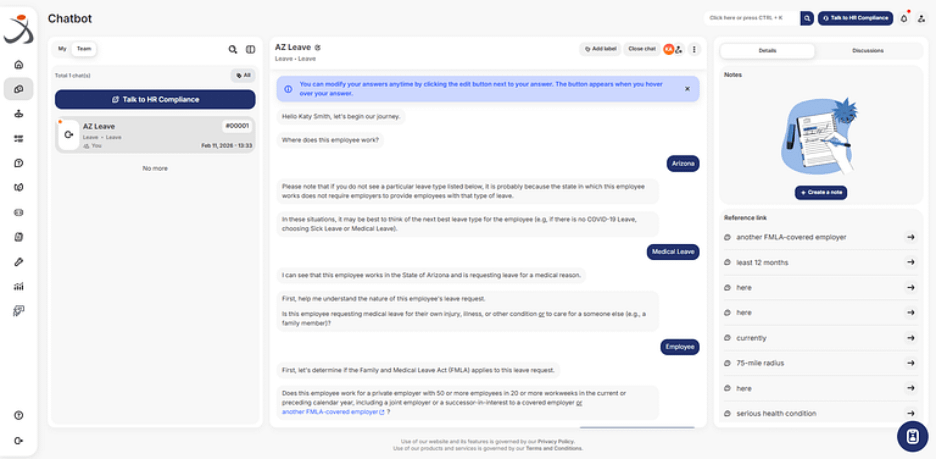
Crucially, the best solutions embed guidance directly into HR workflows like handbook builders, policy templates, manager checklists, and training modules so teams can operationalize decisions immediately. Think: “Is this employee eligible for leave under state law?” answered within the leave workflow, with the correct notices and documentation generated automatically.
Here’s a screenshot of how this could work using Vensure’s HR Compliance tool:
Benefits of Real-Time Compliance Guidance for SMBs
- Faster, more confident HR decisions: When the right answer surfaces in seconds (backed by current citations) HR can move quickly without sacrificing accuracy.
- Reduced compliance risk and human error: Automated prompts, localized requirements, and version control help standardize decisions and reduce variability.
- Less reliance on manual research or legal interpretation: AI HR compliance tools handle the heavy lift of monitoring changes and summarizing implications, reserving counsel time for complex, strategic issues.
- Better support for distributed and multistate workforces: Jurisdiction-specific guidance ensures policies and practices scale cleanly as you enter new locations or hire remote talent.
- Stronger documentation and audit readiness: Embedded workflows produce consistent records, acknowledgments, notices, and time-stamped decisions that support HR compliance risk management.
“Compliance shouldn’t slow organizations down or force HR teams to spend hours interpreting laws,” said Alex Campos, CEO of Vensure Employer Solutions. “With HR Compliance, we’ve embedded intelligent, attorney-backed guidance directly into HR workflows, so organizations can reduce risk, eliminate manual research, and make the right decision the first time.”
How AI Is Changing the Role of HR Teams
For years, HR professionals have acted as policy interpreters, translating dense regulations into day-to-day decisions. With HR compliance automation, that interpretation happens faster and more consistently. This frees HR to focus on strategic work, including:
- workforce planning,
- DEI initiatives,
- manager coaching,
- and employee experience.
Automation also reduces busywork. Instead of manually tracking state posting changes or recreating training logs, AI-enabled systems can trigger alerts, update templates, and capture acknowledgments automatically. HR spends less time chasing updates and more time improving outcomes.
Finally, built-in learning reinforces compliance across the organization. When managers receive point-of-need guidance tied to a specific action (like scheduling, overtime approvals, or leave requests) they develop better judgment over time. The organization becomes more proactive and less dependent on firefighting.
What to Look for in an AI HR Compliance Platform
Choosing the right solution requires more than a flashy chatbot. Look for capabilities that scale with your business and integrate with your HR stack:
- Real-time legal updates: Continuous monitoring of federal, state, and local changes with clear effective dates and practical summaries.
- Jurisdiction-specific guidance: Answers tailored to where employees work, company size thresholds, industry nuances, and union status where relevant.
- Embedded workflows: Handbook builders, policy templates, training assignments, and automated alerts that translate guidance into action.
- Integration with payroll and HR systems: Connections to HRIS, ATS, timekeeping, and payroll so compliance rules can influence scheduling, pay calculations, and records in one place.
- Scalable support for SMB growth: Flexible modules, multi-location management, role-based permissions, and clear audit trails as you expand.
- Transparency and human oversight: Citations, version history, and the ability to consult HR experts when scenarios are novel or high-stakes.
The Future of HR Compliance Is Proactive, Not Reactive
The next frontier of employment law compliance for SMBs is guidance delivered at the point of need. Instead of searching libraries or waiting for a call back, HR teams and managers will see compliant options appear within their existing tools as they work with differences by state, city, and role already accounted for.
As regulations continue to evolve, organizations that invest in real-time guidance will move faster with greater confidence. They’ll onboard in new states more smoothly, manage policy updates with less friction, and give managers the clarity they need to lead effectively.
To learn more about how VensureHR connects SMBs with practical, AI-enabled compliance solutions, connect with us.
AI-enabled Compliance Solutions
One Connected Platform for Confident, Compliant HR Decisions
Note: This article is for informational purposes only and does not constitute legal advice. For specific questions, consult your legal counsel.
The post How Real-Time AI HR Compliance Guidance Helps Businesses Reduce Risk appeared first on VensureHR.
VensureHR